How Much Does It Cost to Build a SaaS MVP in 2026

It's the first question every founder asks. And every agency gives the same frustrating answer: "It depends."
Here's the truth: most SaaS MVPs cost between $25,000 and $75,000. But that range is only useful if you understand what pushes you toward the lower or higher end.
After building MVPs for dozens of startups, I'll break down exactly where the money goes, what timeline to expect, and how to avoid the budget mistakes that kill early-stage products.
TL;DR: SaaS MVP Cost Ranges
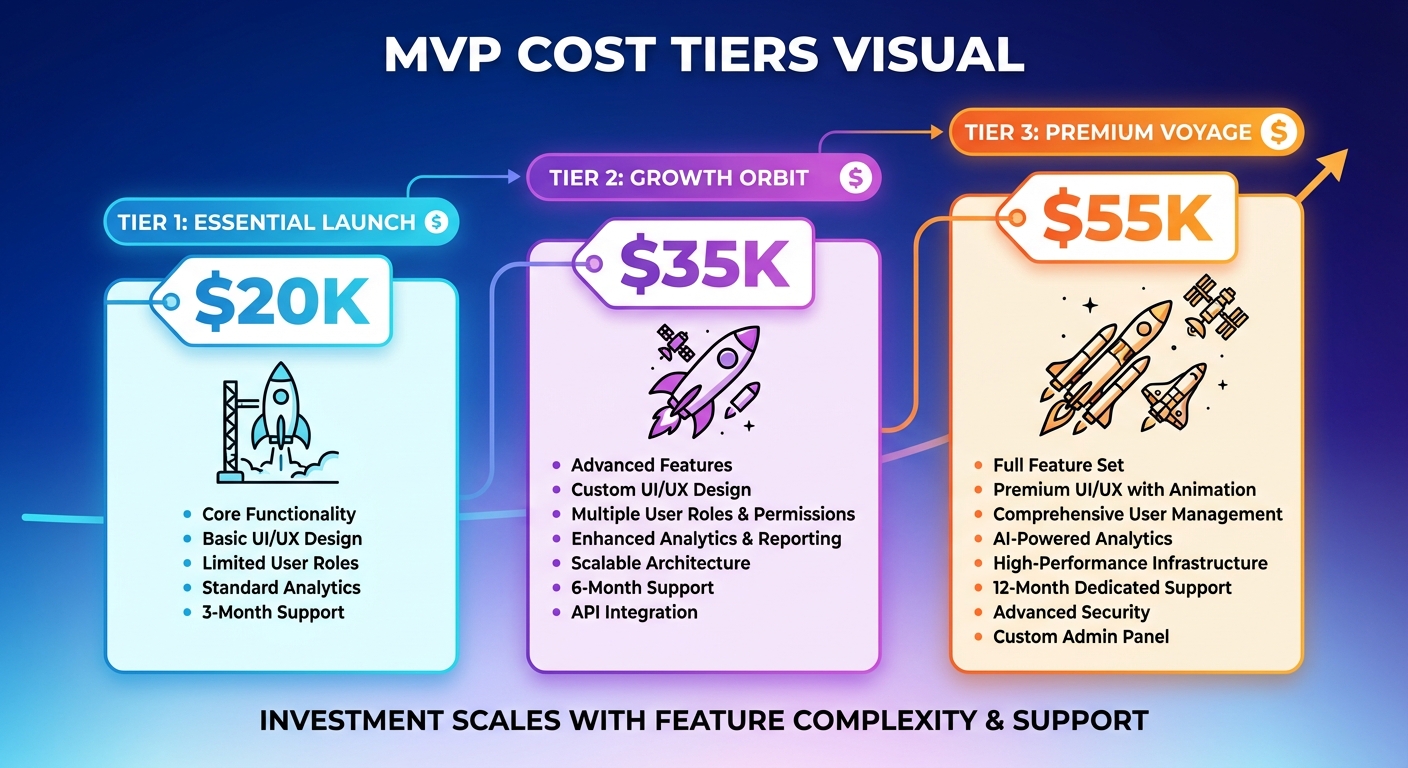
| MVP Scope | Cost Range | Timeline | Example |
|---|---|---|---|
| Simple MVP (core feature only) | $20,000 - $35,000 | 6-8 weeks | Single-purpose tool, basic dashboard |
| Standard MVP (3-5 core features) | $35,000 - $55,000 | 8-12 weeks | SaaS with auth, dashboard, billing, one integration |
| Complex MVP (multiple user types, workflows) | $55,000 - $80,000 | 12-16 weeks | Marketplace, multi-tenant platform, complex permissions |
These assume a professional development team charging $50-100/hour. You can find cheaper options, but cutting corners on your MVP usually costs more in the long run.
What Actually Goes Into an MVP Budget
Let's break down where the money actually goes. Here's a realistic component breakdown:
Core Components (Every SaaS Needs These)
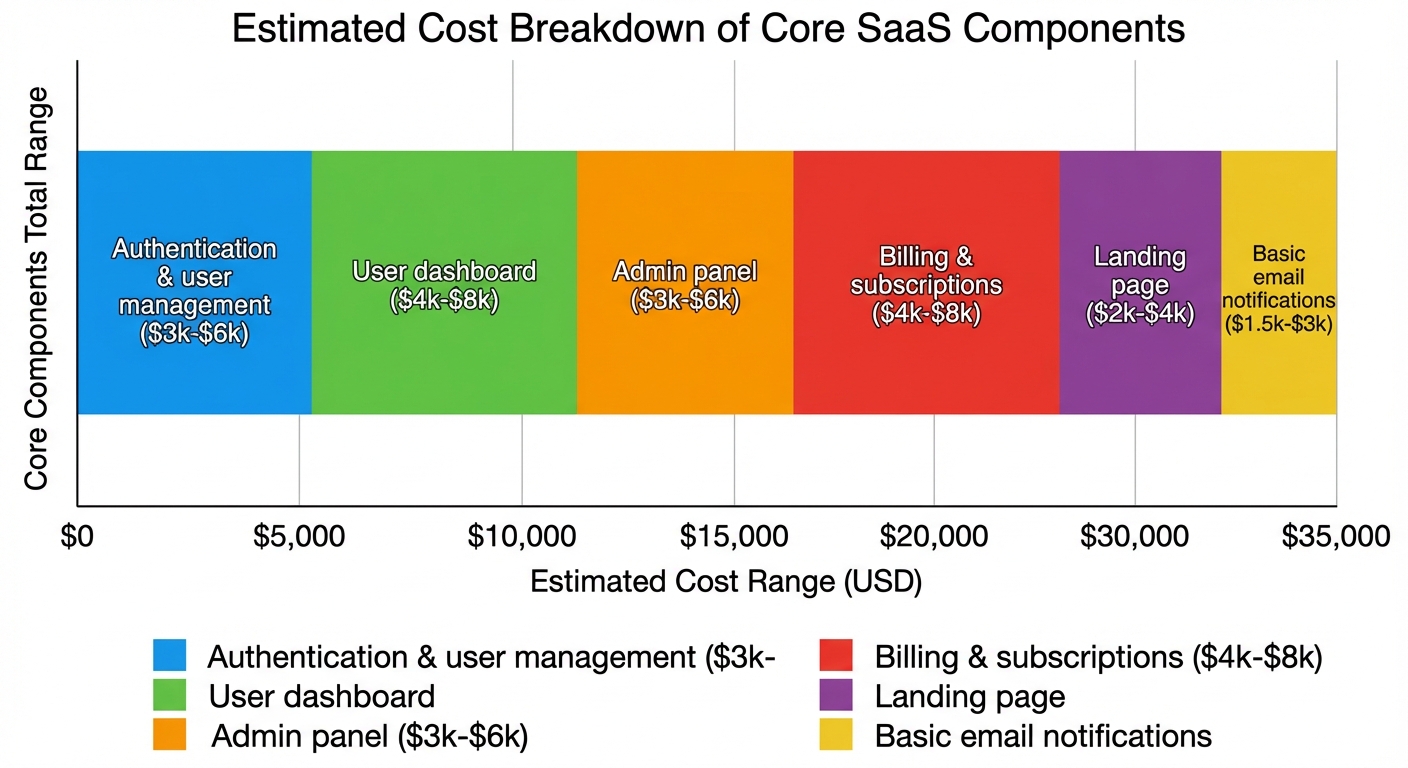
| Component | Cost Range | Notes |
|---|---|---|
| Authentication & user management | $3,000 - $6,000 | Email/password, social login, password reset |
| User dashboard | $4,000 - $8,000 | Depends on complexity and data displayed |
| Admin panel | $3,000 - $6,000 | User management, basic analytics |
| Billing & subscriptions | $4,000 - $8,000 | Stripe integration, plan management, invoices |
| Landing page | $2,000 - $4,000 | Conversion-focused, responsive |
| Basic email notifications | $1,500 - $3,000 | Transactional emails, templates |
Subtotal for basics: $17,500 - $35,000
Your Unique Features (The Actual Product)
This is where costs vary wildly. Your core feature — the thing that makes your SaaS valuable — could be:
- Simple: A form builder, basic automation, data visualization → Add $8,000 - $15,000
- Medium: Custom workflows, reporting engine, third-party integrations → Add $15,000 - $30,000
- Complex: Real-time collaboration, AI/ML features, complex calculations → Add $30,000 - $50,000+
Often Forgotten (But Essential)
| Component | Cost Range | Why It Matters |
|---|---|---|
| Testing & QA | $3,000 - $6,000 | Catch bugs before users do |
| Deployment & DevOps | $2,000 - $4,000 | CI/CD, monitoring, environments |
| Security basics | $2,000 - $4,000 | HTTPS, data encryption, secure auth |
| Documentation | $1,000 - $2,000 | API docs, user guides |
Timeline Expectations (Be Realistic)
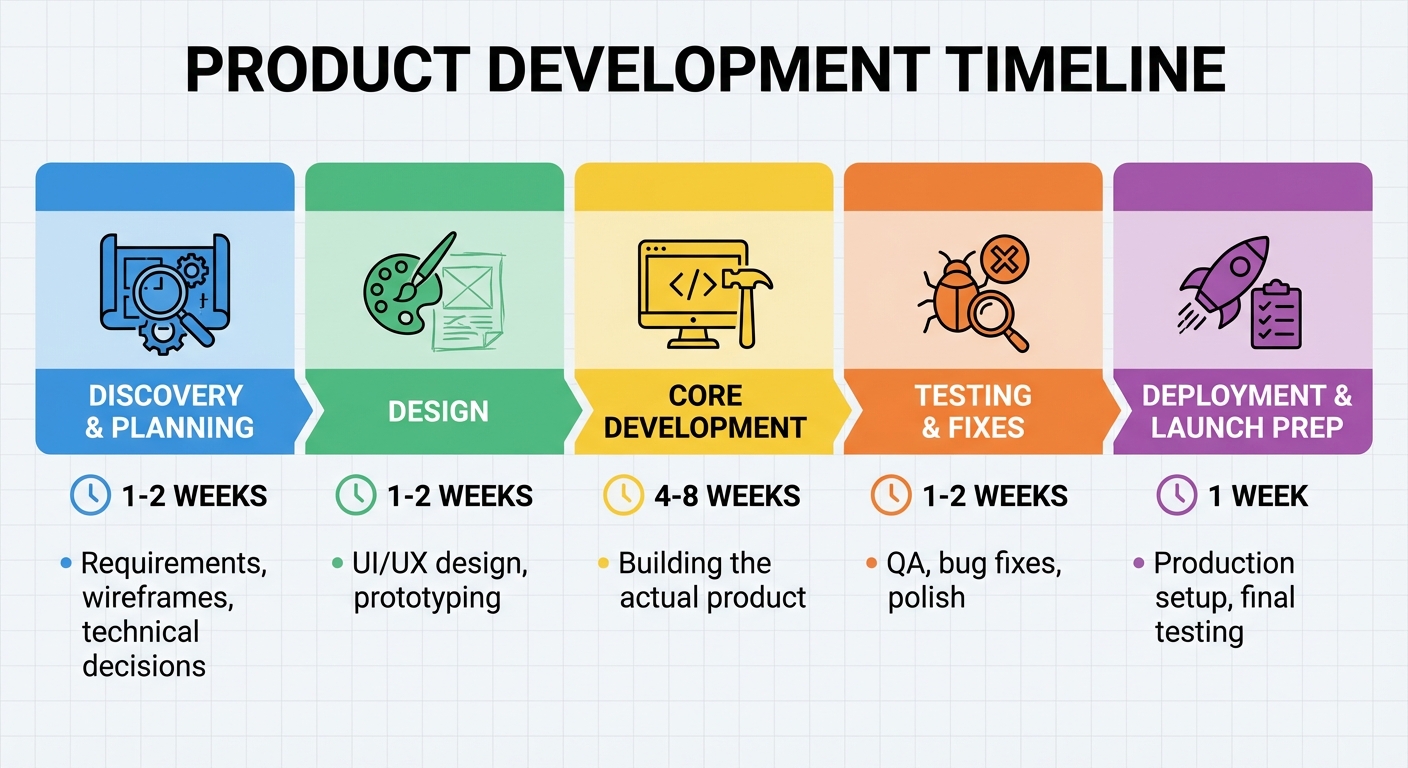
Here's what a typical MVP timeline looks like:
| Phase | Duration | What Happens |
|---|---|---|
| Discovery & planning | 1-2 weeks | Requirements, wireframes, technical decisions |
| Design | 1-2 weeks | UI/UX design, prototyping |
| Core development | 4-8 weeks | Building the actual product |
| Testing & fixes | 1-2 weeks | QA, bug fixes, polish |
| Deployment & launch prep | 1 week | Production setup, final testing |
Total: 8-15 weeks for most MVPs
If someone promises to build your SaaS MVP in 4 weeks, they're either:
- Building something extremely simple
- Cutting corners you'll pay for later
- Using no-code tools (which have their own tradeoffs)
What Drives Costs Up
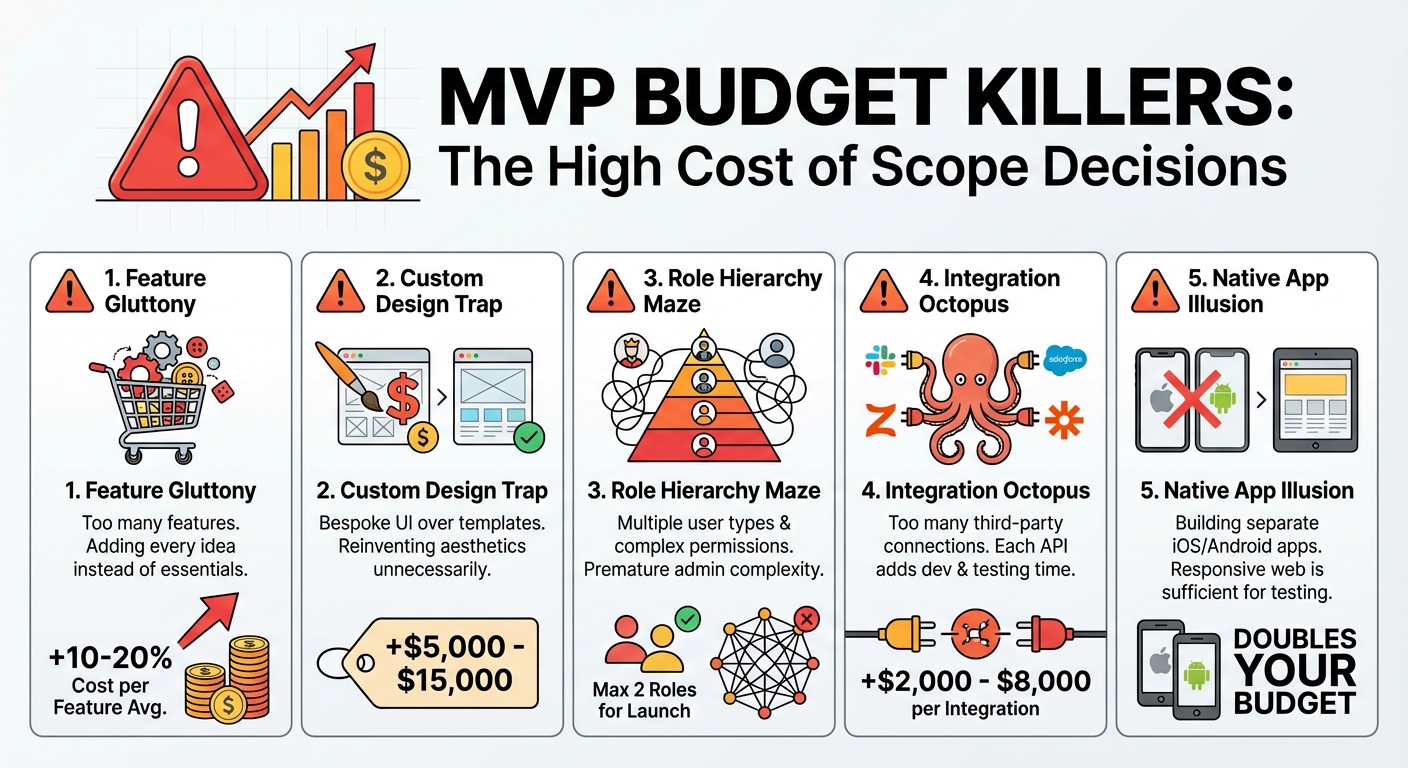
These are the scope decisions that inflate MVP budgets:
1. Too many features
The #1 budget killer. Every feature you add increases cost by 10-20% on average. Be ruthless about what's truly essential for launch.
2. Custom design (when templates would work)
Custom UI design adds $5,000-$15,000. For an MVP, well-chosen templates or design systems often work just fine.
3. Multiple user types with different permissions
Admin, user, manager, viewer... each role adds complexity. Start with 2 roles max for your MVP.
4. Integrations
Each third-party integration (Slack, Salesforce, Zapier) adds $2,000-$8,000. Pick 1-2 essential integrations for launch.
5. Mobile apps
A responsive web app works on mobile. Native iOS/Android apps double your budget. Don't build mobile apps for your MVP unless mobile is absolutely core to your value proposition.
What Keeps Costs Down
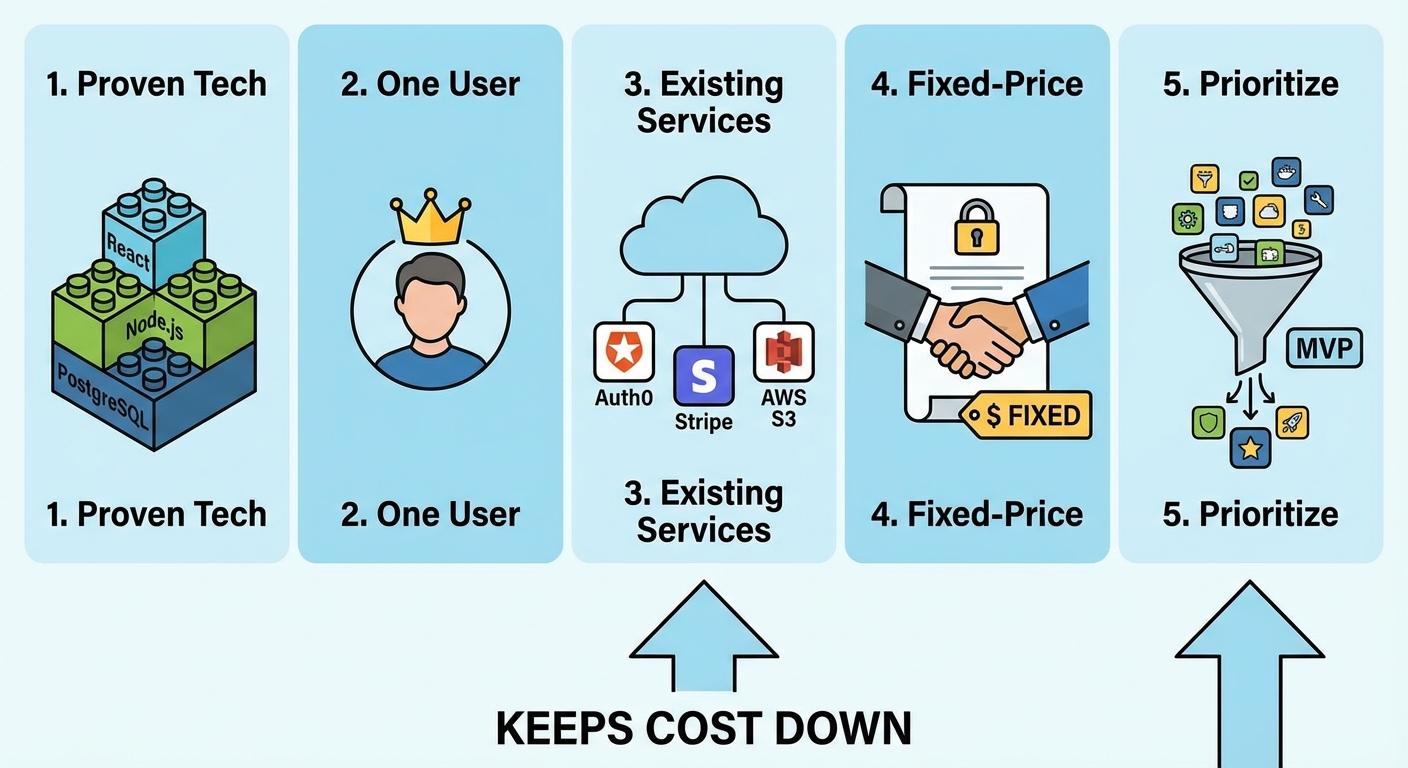
1. Use proven tech stacks
Exotic technologies mean longer development time and fewer available developers. Stick to mainstream: React/Next.js, Node.js, PostgreSQL/MongoDB.
2. Start with one user type
Build for your primary user first. Add admin features and other roles in v2.
3. Use existing services
Auth (Auth0, Clerk), payments (Stripe), email (SendGrid), file storage (AWS S3) — don't build what you can buy.
4. Fixed-price contracts
Hourly billing can spiral. Fixed-price contracts force scope discipline and protect your budget.
5. Prioritize ruthlessly
Make a list of features. Cut it in half. Then cut it again. What's left is your MVP.
Agency vs. Freelancer vs. In-House
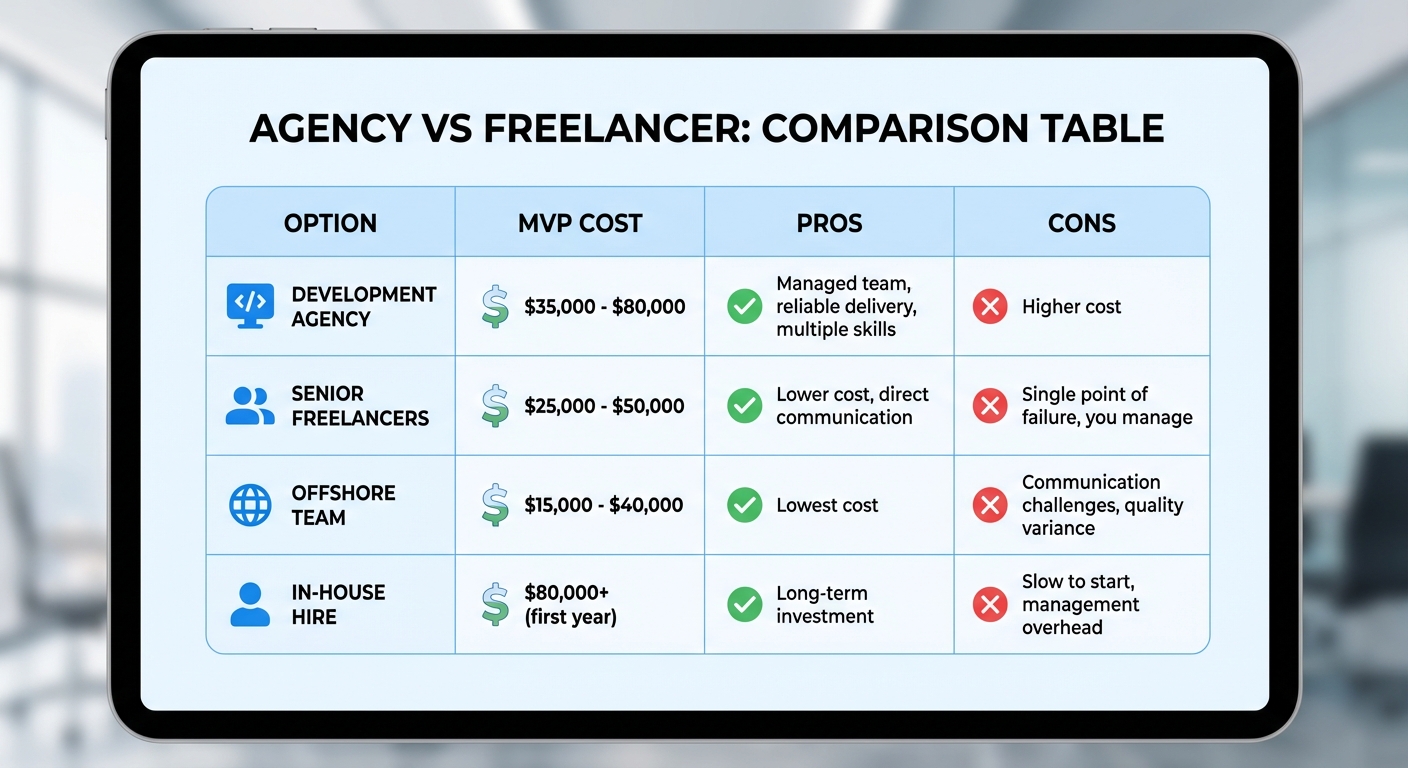
| Option | MVP Cost | Pros | Cons |
|---|---|---|---|
| Development agency | $35,000 - $80,000 | Managed team, reliable delivery, multiple skills | Higher cost |
| Senior freelancers | $25,000 - $50,000 | Lower cost, direct communication | Single point of failure, you manage |
| Offshore team | $15,000 - $40,000 | Lowest cost | Communication challenges, quality variance |
| In-house hire | $80,000+ (first year) | Long-term investment | Slow to start, management overhead |
For most first-time founders, an experienced freelancer or small agency is the sweet spot. You get quality work without enterprise pricing.
How We Approach MVP Projects
At Freelancelyst, we've developed a process specifically for MVPs:
1. Scope workshop (free) We spend 1-2 hours understanding your product, users, and business model. No commitment — just clarity on what you actually need.
2. Fixed-price proposal You get a detailed scope document and fixed price. No surprises, no hourly billing anxiety.
3. 2-week sprints We ship working features every two weeks. You see progress, give feedback, and can adjust priorities.
4. Launch-ready delivery We don't just write code. We deploy to production, set up monitoring, and make sure you're ready for real users.
Red Flags to Watch For
When evaluating MVP development partners, be wary of:
- No discovery phase — If they quote without understanding your product, they'll miss requirements
- Vague estimates — "It could be $20K or $100K" means they don't know what they're doing
- No portfolio of shipped products — Building MVPs is a specific skill
- Pushing complex solutions — A good partner suggests simpler alternatives, not more expensive ones
- No fixed-price option — Hourly-only billing puts all the risk on you
Real Talk: Is Your MVP Too Expensive?
If quotes are coming in higher than expected, ask yourself:
-
Is the scope too big? Most MVPs try to do too much. What's the one thing users need?
-
Are you building for scale too early? You don't need to handle 1 million users on day one. Build for 100 users first.
-
Are you designing too much? Sketch the UI, but don't perfect it. MVP means minimum viable.
-
Are you in the right market? US/UK agencies charge $150-200/hour. Eastern European teams charge $50-80/hour for equivalent quality.
Next Steps
Ready to scope your MVP? Here's what to do:
- Document your core user flow — What's the main thing users will do in your product?
- List your must-have features — Be honest about what's essential vs. nice-to-have
- Define success — What metrics will tell you the MVP worked?
Then schedule a free scope call with our team. We'll help you refine the requirements and give you a realistic budget.